St. Pete eyes $600 million resiliency bond to tackle flooding and harden city infrastructure
/A FLOODED STREET IN sT. pETERSBURG DURING hURRICANE helene | cITY OF sT. pETERSBURG
Heavy rainfall and storm surge have exposed serious vulnerabilities in St. Pete's aging infrastructure over the years, and the city is now asking whether a $600 million bond is the right tool to fix it faster.
Last Thursday, the City's Budget, Finance, and Taxation Committee discussed placing a General Obligation (GO) bond referendum on the November 2026 ballot.
The proceeds would fund a portion of projects under the St. Pete Agile Resilience (SPAR) program, a city-led initiative to accelerate flood protection, stormwater improvements, and utility system hardening before the next major storm arrives.
The $2.7 billion SPAR program, which will be set up regardless of a potential November referendum, will be funded through utility fees.
Without the bond, that work gets spread over 24 years through fiscal year 2050 as utility revenue accumulates.
What the proposed $600 million GO bond would do is front-load roughly five years of construction, compressing the timeline to 19 years by injecting bond proceeds into the early years of the program, roughly 2027 through 2031, while utility rate funding continues alongside it.
the implementation of GO bonds would enable the city to undertake large-scale projects at a quicker pace | city of st. petersburg
The bond doesn't replace utility funding. It stacks on top of it, allowing the city to build faster than utility revenue alone would permit.
If the GO bond is approved, it would allow the city to fund an additional $120 million in infrastructure upgrades per year, in addition to the expected SPAR infrastructure spend of approximately $110 million per year.
The estimated cost to property owners would be around 0.96 mills, or $96 annually per $100,000 of taxable value, which the city says is cheaper than the $486 annual utility rate increase that would otherwise be needed to match the same pace of construction.
Over the past decade, St. Pete has invested roughly $1.15 billion in infrastructure upgrades across the city.
The bulk of that went to the three systems at the heart of the SPAR program: sewer utilities received approximately $510 million, water utilities around $161 million, and stormwater utilities another $17 million.
The city plans to spend $4.4 billion through FY2050 on its Capital Improvement Project, SPAR is expected to reflect $2.7 billion of that total | cITY OF sT. pETERSBURG
Despite that level of investment, the city says it still isn't enough, and that the damage and operational failures exposed by Hurricanes Helene and Milton made that clear.
SPAR projects are a subset of the city's broader Capital Improvement Program (CIP), which covers $4.4 billion in stormwater, water, and wastewater work through 2050.
The difference between a SPAR project and a non-SPAR project comes down to what a project actually accomplishes.
Replacing a piece of aging infrastructure is routine capital work. SPAR projects go further, rebuilding or hardening that same infrastructure so it can withstand future storms rather than just extending its useful life.
A lift station outside a flood zone gets replaced at ground level as routine maintenance. The same replacement inside a flood zone gets elevated above it, and that's within the scope of SPAR.
A manhole in St. Petersburg | cITY OF sT. pETERSBURG
Currently, all of it gets paid for through utility fees.
The problem is that the cost burden falls unevenly under that model. A landlord who owns a commercial building connected to city water and sewer pays utility fees and therefore contributes to infrastructure funding. But a property owner whose land sits vacant, may pay no utility fees at all, yet still benefits from the broader resilience of the city's stormwater and flood protection systems.
The GO bond would make everyone with taxable property contribute, regardless of whether they're a utility customer.
"While pay-as-you-go [using utility fees] avoids interest payments, it does carry a high risk of inflation, construction delays, and in many cases higher total costs due to rising material and labor prices," Public Works Administrator Claude Tankersley told the committee. "Construction delays also carry the risk of flooding events occurring before those resilience upgrades can be constructed."
An overview of the 5-year stormwater SPAR spending if the GO bonds are approved | City of St. Petersburg
Representative projects span all three major utility systems.
On the stormwater side, the Shore Acres Flood Gate System and Clam Bayou Tidal Protection Gate would protect low-lying coastal neighborhoods from tidal backflow, the kind of sunny-day flooding that doesn't require a named storm.
Drainage improvements are proposed for Bear Creek, Edgemoor, Emerald Lake, and Jorgensen Lake.
Water infrastructure projects focus on replacing aging transmission mains and hardening supply pump stations with generator backup, the type of work that could have prevented the prolonged boil water notice that followed Hurricane Milton.
Wastewater projects include wet weather storage tanks and new operations buildings engineered to withstand Category 5 winds and a 15-foot storm surge, allowing plant staff to keep systems running during extreme weather rather than shutting down.
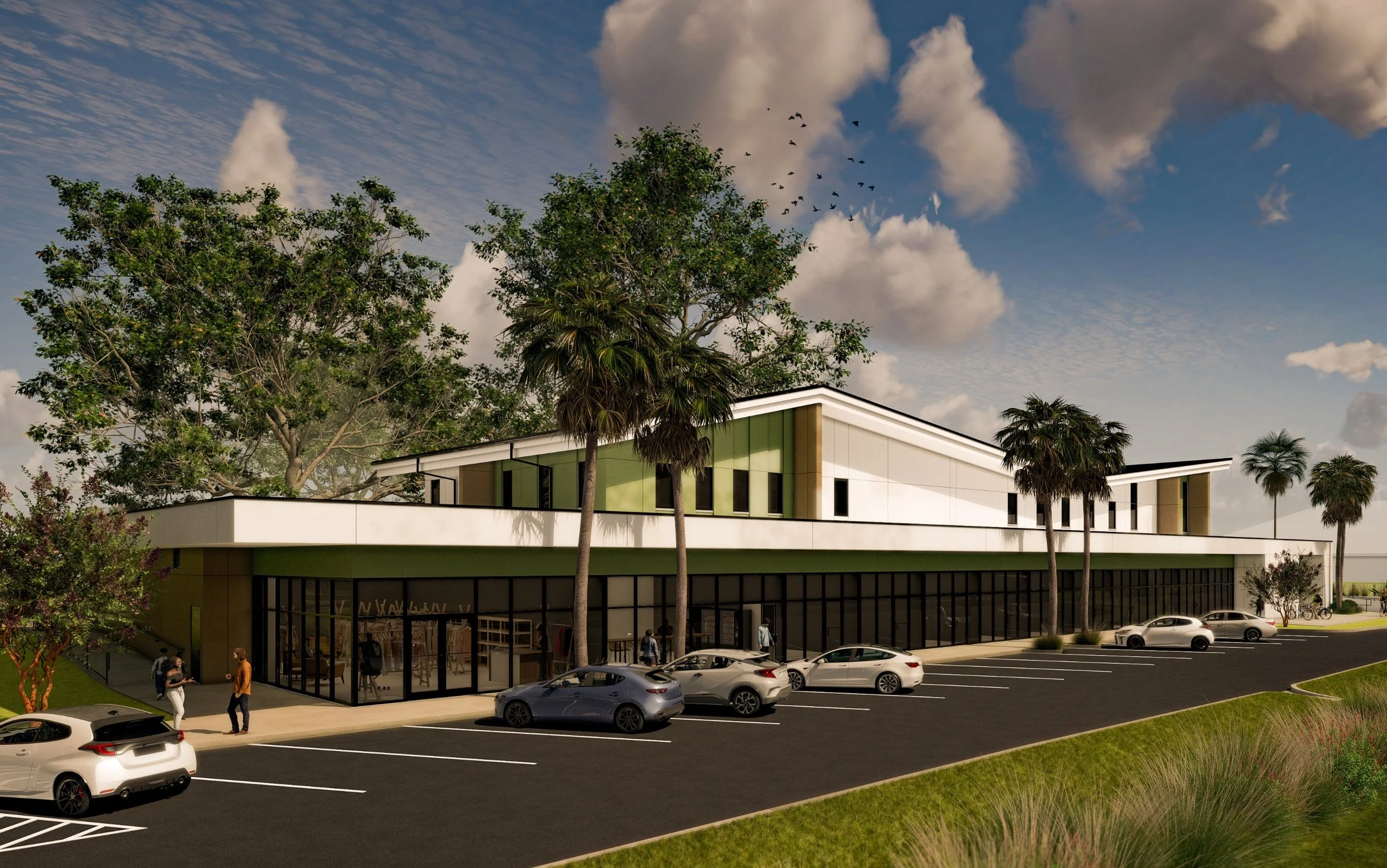
A planned Operations and Maintenance Building at the Southwest Water Reclamation Facility | City of St. petersburg
The project list is described as representative rather than binding, and priorities could shift as community needs and project feasibility evolve.
Not all committee members were sold on placing a General Obligation (GO) bond referendum on the November ballot.
Councilmember Brandi Gabbard, whose District 2 sits 95% within the coastal high hazard area, raised concerns about how unevenly the representative projects are distributed. District 4 wouldn't see a single project within its boundaries, while other districts range from 8% to 23% of the total.
"That is not a clear spread across the city and prioritizing the areas of greatest need," Councilwoman Gabbard said.
The city’s engineering team responded that the listed projects represent the most critical current needs and that the impact of any single project typically extends beyond its immediate location.
Councilmembers Gina Driscoll and Mike Harting echoed concerns about economic timing, noting that many residents are already stretched thin and an additional property tax line item is a hard sell.
The aquafence installation at Lift Station 85 | the city of st. petersburg
Harting also raised a harder philosophical question, pointing to the millions spent hardening the Northeast Sewer Treatment Plant after crews had to shut it down for 12 hours ahead of Hurricane Milton's landfall.
"Those millions of dollars could have gone to projects that we can't fund now because of that," Councilman Harting said. "How do we go through that process of how resilient is too resilient? That's a tough question."
The engineering team acknowledged the concerns and will work to address them before the GO bond item goes to the Public Services and Infrastructure Committee on May 14th.
If that process moves forward on schedule, St. Pete voters could see the question on their ballots this November, a straight up-or-down vote on whether to accelerate the city's resilience buildout, and who pays for it.