Historically St. Pete: The legacy of M.B. Welch, a lesser-known builder who helped shape St. Pete during the 1920s boom
/MB Welch constructed the San Rafel Hotel in 1925 | St Petersburg Museum of history
At St. Pete Rising, we are constantly providing comprehensive coverage on everything new and coming soon to the Sunshine City, but we think it’s also important to take a look back at our city's rich history.
Historically St. Pete, a monthly column on St. Pete Rising written by Executive Director of the St. Petersburg Museum of History Rui Farias, covers everything from the legend of underground mobster tunnels to the buildings and people that created the Sunshine City.
Follow us each month as we explore how these projects shaped St. Pete into the city we know and love today.
This month, we look back at the legacy of M.B. Welch, a lesser-known builder who constructed more than 300 homes and several apartment buildings during St. Petersburg’s 1920s boom, many of which still stand today.
MB Welch and his wife Mary in front of the San Rafel apartments | St. Petersburg Museum of History
In 1925, the St. Petersburg Times described him as “one of the most prominent apartment house builders of St. Petersburg, as well as one of the most popular contractors of this community.”
M. B. Welch never commanded the headlines of developers like C. Perry Snell or the Walter Fuller father-and-son team, yet much of what Welch built during the 1920s boom still stands.
In today’s era when the Mediterranean Revival style that once defined St. Petersburg is steadily disappearing, his work remains a testament to his craftsmanship.
When Welch arrived from Indiana in 1923, St. Petersburg was already caught up in the craziness of the Florida land boom.
The son of a carpenter, Welch was drawn by the same promise that lured thousands during the Jazz Age: sunshine, opportunity, and prosperity.
Without fanfare, he set off to build St. Pete. He found success quickly.
Welch first went to work for a local contractor, learning how to build a house with proper ventilation for the humid Florida climate, prior to the advent of the home air conditioner.
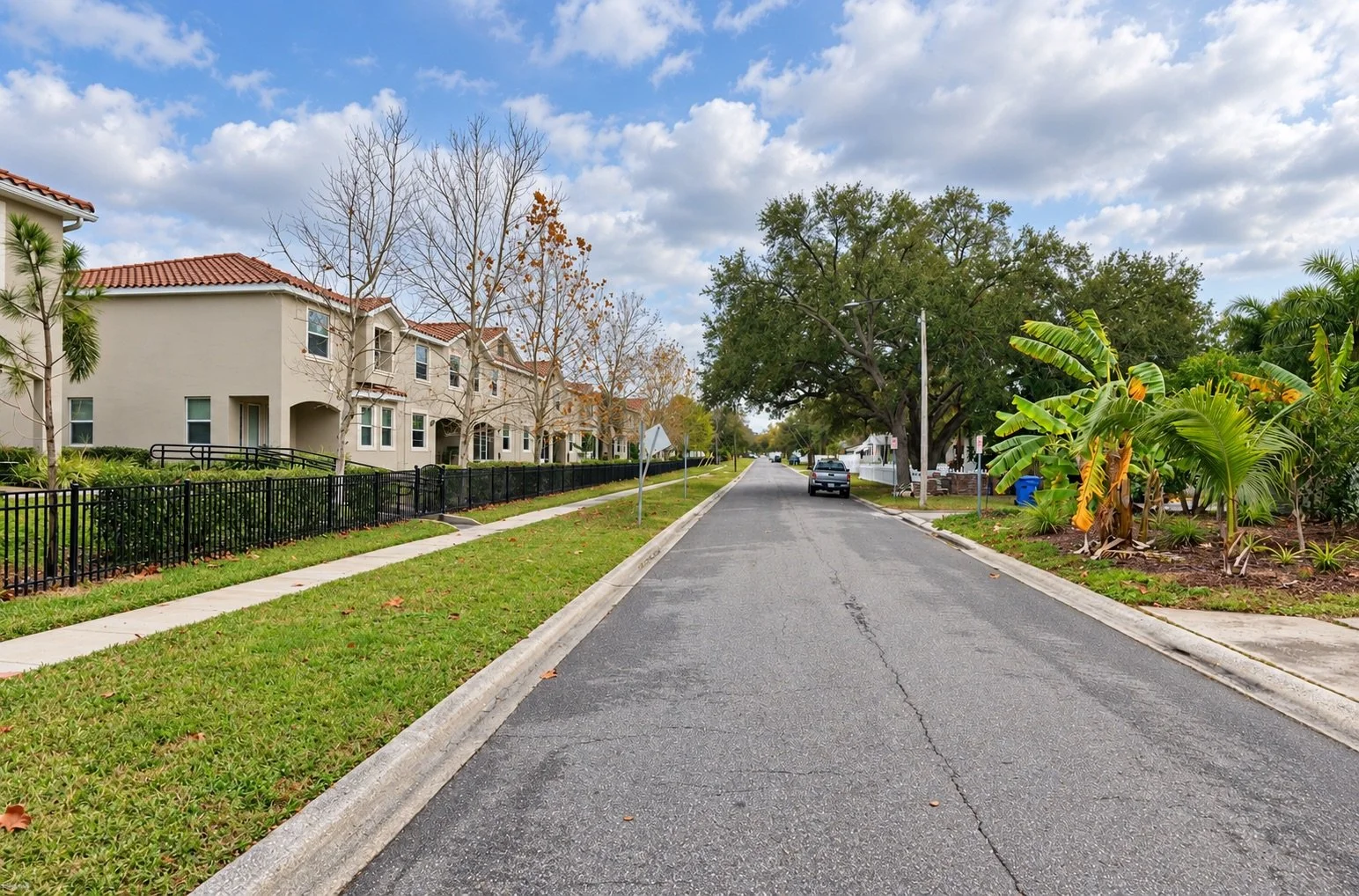
in the 1920’s, M.B. Welch built 10 single-family homes along 19th Avenue Northeast. In 2018, the block was designated a local historic district | Multiple sources
He then formed M.B. Welch, Inc. and created one of the largest construction firms in the area, employing 400 workers at its peak.
Welch built more than 300 residences across St. Petersburg. His work can still be found in neighborhoods such as Snell Isle, Grenada Terrace, Old Northeast, Lakewood Estates, Woodlawn, Crescent Lake, and Pass-a-Grille.
He favored hollow tile block construction with stucco finishes, often sourced from the Ford Concrete Foundries, materials that became synonymous with the Mediterranean Revival style.
One of his most recognizable contributions is “Mediterranean Row” along 19th Avenue Northeast.
Just east of 1st Street North, ten single-family homes offer a remarkably intact glimpse into life in 1925 St. Petersburg.
In 2018, the block was designated a local historic district.
However, Welch’s building talents extended well beyond single-family homes. His multi-family buildings, particularly in the Old Northeast, continue to provide residents a connection to 1920s St. Pete and a place to call home.
MB Welch constructed the San Rafel Hotel in 1925 | Facebook
The San Rafel Hotel (now San Rafael Apartments) at 13th Avenue Northeast and Locust Street was among the city’s earliest cooperative living concepts.
Built in 1925, it combined the conveniences of a modern hotel with the privacy of a home.
The Mediterranean Revival structure featured soundproof apartments, street-level retail, and direct access to the North Shore/Coffee Pot trolley line and a quick hop to downtown.
Units ranged from $3,000 to $8,000 for a penthouse.
Nearby, at 1206 Oak Street Northeast, Welch constructed the Ray-Johnson Apartments (now El Mirasol) in 1926. This 16-unit building cost $45,000 to complete.
In 1927, Welch built the Inezda Apartments on Beach Drive and 12th Avenue Northeast, offering sweeping views of Tampa Bay.
Outfitted with modern conveniences such as gas stoves and electric heat, total seasonal rent, January to April, ranged from $450 to $1,000.
In 1927, MB Welch built the Inezda Apartments on Beach Drive and 12th Avenue Northeast | CoStar
Not all of Welch’s work catered to seasonal residents though.
That same year, he built the Parks Apartments at 1151 34th Avenue North for year-round living.
Designed to combat Florida’s heat, each unit featured enclosed front and rear porches, along with windows in every room to maximize airflow and ventilation. Rents began at $50 per month.
Welch also contributed to the city’s recreational life.
He constructed the St. Petersburg Roque Club building at Mirror Lake, built and donated the city’s first outdoor basketball court, and sponsored a baseball team, the “Welchmen”, which won St. Petersburg’s first City Baseball League championship.
Like so many developers, Welch’s success was halted by the collapse of the Florida land boom in 1928, followed by the onset of the Great Depression.
Forced to seek work elsewhere, he traveled to Alabama and back to Indiana to support his family.
He returned to St. Petersburg briefly in 1939, but in 1944 relocated to Tennessee, where he built housing for military personnel and workers involved in the atomic bomb project.
Welch came back once again in 1957. In his later years, he built homes in the Gateway Mall area and oversaw construction of the Derby Club at Derby Lane.
He retired at 83 and passed away in 1989 at the age of 94.
Today, though his name is less widely known, M.B. Welch’s legacy is written across the city – one structure at a time.