New Port of St. Pete renderings show cruise terminal, park, and dining, but questions remain
/A potential redevelopment of the Port of St. Petersburg could include a public park, cruise terminal, superyacht marina, waterfront promenades, and dining options | Moffatt & Nichol
A long-term vision for the city’s port could reshape the Bayboro Harbor waterfront just south of downtown St. Pete, but early reactions from city officials suggest the path forward remains uncertain.
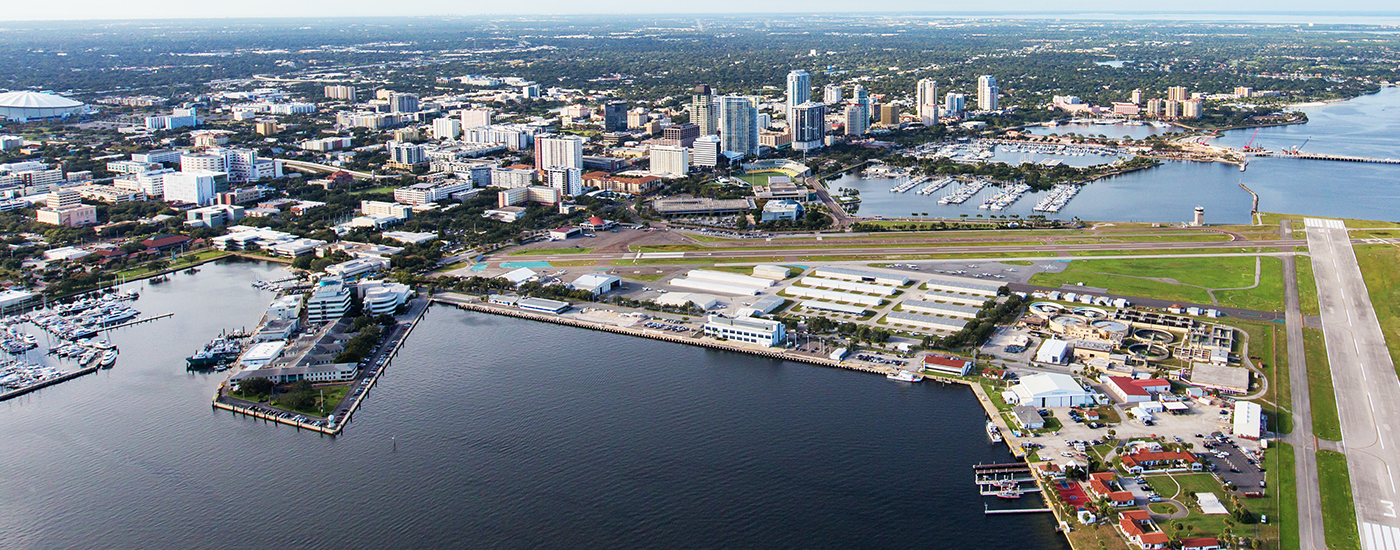
The approximately 4.4-acre portion of the city-owned Port of St. Petersburg at 250 8th Avenue SE is being studied for a potential redevelopment that could include a public park, cruise terminal, superyacht marina, waterfront promenades, and dining options.
Located within the Innovation District and surrounded by major institutions — including the University of South Florida St. Petersburg campus to the west, Albert Whitted Airport to the north, and the U.S. Coast Guard to the east — the site is seen as an opportunity to expand both public access and maritime activity.
At a March 12th Public Services and Infrastructure Committee meeting, consultants from Moffatt & Nichol presented a draft master plan that reimagines the port as a mixed-use waterfront destination.
The approximately 4.4-acre portion of the city-owned Port of St. Petersburg is being studied for a potential redevelopment | Google Maps
“The intent here is to maintain the Port’s operational role while enhancing the waterfront experience,” said Stephen Romanin, a landscape architect and waterfront planner with Moffatt & Nichol.
The proposal represents the first major update to the port’s long-term vision since 1999, when city leaders explored a concept known as “Port Discovery.”
That effort was ultimately abandoned after projected costs escalated to around $72 million, significantly beyond initial estimates.
More than two decades later, the city commissioned a new study to evaluate how the port could be better utilized.
“From the start, one message was clear: the Port is an underused asset ready to reach its full potential,” the draft plan states.
The West Wharf Gateway & Harborside Park would serve as the port’s front door, featuring public park space, waterfront promenades, event areas, and dining options | Moffatt & Nichol
The master plan organizes the site into several key zones that combine public access with maritime infrastructure:
The West Wharf Gateway & Harborside Park would serve as the port’s front door, featuring public park space, waterfront promenades, event areas, and dining options.
The St. Petersburg Terminal & Cruise Center would introduce a passenger terminal and cruise berth capable of accommodating vessels up to 600 feet, supporting the continued growth of small cruise operations already using the port.
The Recreational Boating & Yacht Precinct would expand marina capacity, particularly for larger vessels and superyachts, while incorporating a Marine Operations Center and public waterfront access.
The eastern portion of the site would be anchored by an MRO (maintenance, repair, and operations) facility, supporting vessel servicing and other marine industry uses.
Port of St. Pete Master Plan | Moffatt & Nichol
The plan also accounts for the existing Maritime and Defense Technology Hub, which opened in 2022 at 450 8th Avenue SE and is fully occupied by marine science and defense-related companies.
A potential second facility, referred to as “Hub 2.0,” could expand research and collaboration space on nearby land.
Romanin noted that the Port plan is intentionally flexible, allowing the property to adapt over time depending on market demand and evolving priorities.
“As we progress through design and implementation, the plan has the capacity to adapt and shift as needed,” he said.
While the vision includes a mix of public-facing amenities and maritime uses, several committee members questioned whether the plan places too much emphasis on restaurants and recreational spaces rather than prioritizing job-generating marine industries.
The St. Pete Terminal & Cruise Center would introduce a passenger terminal and cruise berth capable of accommodating vessels up to 600 feet | Moffatt & Nichol
“I view this as more industrial and marine science-focused,” Vice Chair Richie Floyd said. “It’s a hard area to activate for that type of [entertainment] usage.”
Council Member Gina Driscoll also emphasized the importance of the port’s deepwater access, particularly for marine-related research being conducted at the Maritime and Defense Technology Hub.
Others questioned whether the plan fully considers nearby assets, including the municipal marina, private marinas, and planned redevelopment along Salt Creek.
“I think my biggest concern is that this is about much more than just the port,” said Council Member Brandi Gabbard. “We’re talking about the Harborage, Salt Creek, the municipal marina, the Center for the Arts — all of these pieces need to work together. My concern is that we’re studying them in silos.”
Cost was another major point of discussion. Preliminary estimates place the full buildout between approximately $159 million and $270 million, not including soft costs or future inflation.
“These are the numbers today,” said Council Chair Lisset Hanewicz. “These numbers do not compute the cost in year five, in year 10, in year 20.”
The Recreational Boating & Yacht Precinct would expand marina capacity, particularly for larger vessels and superyachts | Moffatt & Nichol
Council Member Driscoll also expressed concern, saying, “We subsidize the Pier right now. We don’t need to take on something else to subsidize.”
City staff and consultants emphasized that the plan is not intended to be built all at once, but rather implemented in phases over 10-20 years, potentially supported by a combination of grants and public-private partnerships.
“We’re not looking to pay for it all at once. It’s going to be a phased approach,” said City Development Administrator David Wirth. “There are a lot of grant dollars out there for ports.”
Despite the debate, officials stressed that the proposal remains conceptual and does not represent a final decision.
“There has been zero input from the City Council and administration at this time,” said Driscoll. “We are simply taking in the results of the first part of developing a plan. What we will end up with will look very different.”
Council Member Mike Harting described the plan as a “dream board,” reflecting early ideas rather than a defined path forward.
Moffatt & Nichol is expected to continue refining the proposal before presenting a finalized version to the St. Petersburg City Council later this year, where a broader discussion will take place on the future of the port and its role in the city’s waterfront.
The St. Pete Terminal & Cruise Center would introduce a passenger terminal and cruise berth capable of accommodating vessels up to 600 feet | Moffatt & Nichol