Downtown St. Pete’s Albert Whitted Airport could see future air taxi service
/The City of St. Pete is preparing for electric “air taxis” that could one day carry passengers across Tampa Bay in minutes | City of St. Pete
Would you trade bridge traffic for a 10-minute flight across Tampa Bay?
That scenario may not be as far off as it sounds. Companies around the world are racing to launch electric “air taxis,” and St. Pete could eventually be part of that conversation.
More than a century after the world’s first commercial airline flight lifted off from the downtown waterfront, city leaders are exploring how the next evolution of aviation could take shape at Albert Whitted Airport in downtown St. Pete.
After nine months of meetings, the City of St. Pete’s Advanced Air Mobility Task Force released its final recommendations on how the city can prepare for Advanced Air Mobility (AAM), which is the use of electric vertical takeoff and landing aircraft known as eVTOLs, or “air taxis”.
Think of it as Uber or Lyft, but in the air.
Unlike traditional helicopters, eVTOLs are battery-powered, quieter, and designed for lower operating costs.
According to the task force report, most leading AAM aircraft under development will carry between two and six passengers, fly between 60 and 200 miles, and operate at altitudes between 500 and 3,000 feet.
The first eVTOL aircraft are expected to receive FAA certification within the next one to two years.
Proposed routes could link Albert Whitted Airport with St. Petersburg’s downtown waterfront and extend to regional destinations such as Tampa International Airport and SunTrax in Lakeland, the future home of the nation’s first Advanced Air Mobility testing center.
The Task Force recommends creating AAM flight corridors linking Albert Whitted with Tampa International and other regional airports and vertiports | ESA Airports
Chaired by former City Councilmember, retired American Airlines pilot, and Air Force veteran Ed Montanari, the city’s task force was created in early 2025 to evaluate the role of Albert Whitted Airport and the potential for standalone vertiports throughout St. Pete.
“Advanced air mobility represents the next transformational chapter of aviation and St. Pete is in the position to lead,” Montanari told City Council on Thursday when presenting the final report.
In the short term, within the next three years, the task force recommends preparing the airport to accommodate early eVTOL operations without immediately building a full vertiport, which is a facility designed specifically for vertical takeoff and landing aircraft.
Those initial steps include designating parking areas for AAM aircraft, installing electric charging infrastructure, utilizing existing runways for takeoff and landing, and adding appropriate fire safety systems.
Helicopters at Albert Whitted currently sequence with fixed-wing aircraft before hover-taxiing to parking areas. Montanari said eVTOLs could initially operate in a similar manner.
Within 4 to 10 years, the task force recommends constructing at least one dedicated vertiport at the airport, potentially more if demand grows.
The task force also recommends updating city code to accommodate AAM.
REQUIRED AIRSPACE and potential vertiport sites at Albert Whitted Airport in downtown St. Pete | City of St. pete
“The city currently has no formal process for approving vertiports,” said Montanari in a conversation with St. Pete Rising. “If a building owner wanted to install one tomorrow, there’s no application framework in place. One of our recommendations is to update city code to create that approval process.”
With a process in place and appropriate land and zoning uses defined, vertiports could be built in communities such as the Gateway, Carillon, Tyrone, the Eckerd College campus, the future redeveloped Gas Plant District, and near the Gulf Beaches, according to the task force.
Beyond infrastructure, the group proposed creating a “Jannus Center for Aviation and Innovation” focused on research, education, workforce development, and industry partnerships tied to AAM.
While a specific location has not been identified, Montanari said the center would likely involve collaboration among local technical colleges and industry leaders.
“I want to plant a flag here in St. Petersburg,” Montanari said, emphasizing that the city should lead rather than react as the industry evolves.
With the final report delivered, the task force has sunset.
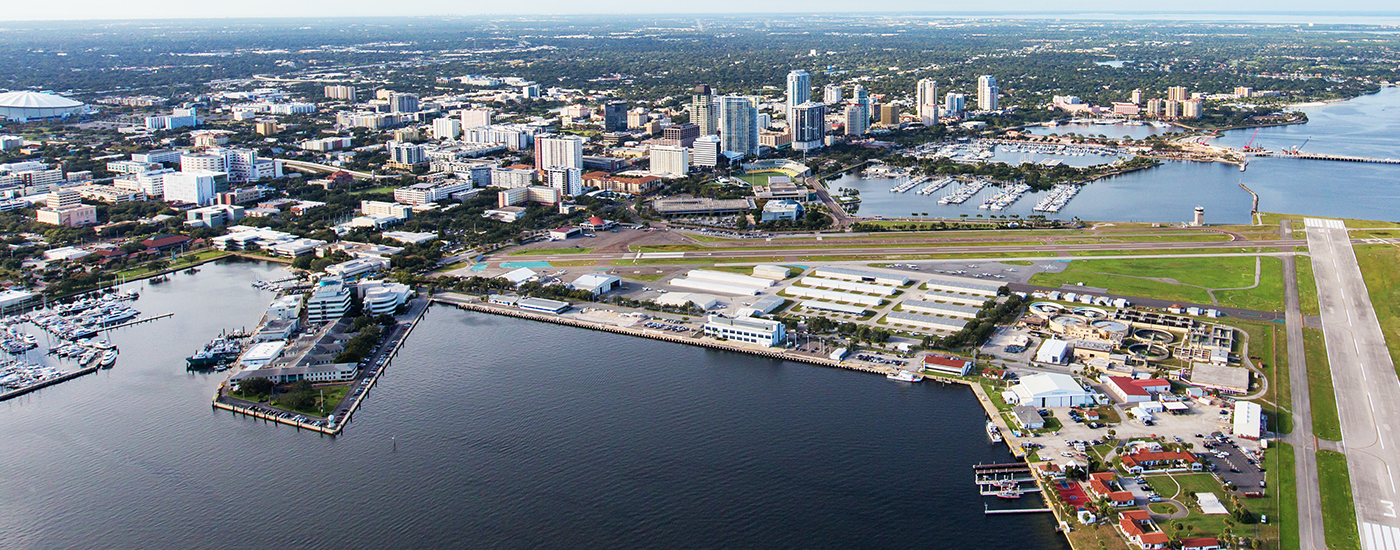
Albert Whitted Airport is a public-use general aviation airport located on the downtown St. Petersburg waterfront, serving private planes, corporate aircraft, and flight training operations | Albert Whitted Airport
The next steps, including whether to fund further study and update city code, now rest with City Council and the mayor.
If the city pursues this endeavor, the task force recommends that it select a consultant through an open procurement process and conduct an alternative analysis study, essentially a “mini master plan”, on Albert Whitted Airport.
St. Petersburg would not be alone in pursuing air taxi infrastructure. Cities around the world are preparing vertiport infrastructure.
Lilium, a German-based aviation company, is building a vertiport in Lake Nona on property owned by the Greater Orlando Aviation Authority. It’s expected to open in 2028.
Additionally, tech company UrbanLink and VertiPorts by Atlantic Aviation will have a network of fixed-base operators and vertiport sites across Miami-Dade, Broward, and Palm Beach counties. The company aims to launch operations in the second half of 2027.
More than 110 years after Tony Jannus’ historic 1914 flight across Tampa Bay, St. Pete is again weighing whether it wants to help shape aviation’s next chapter.